

The database returns nothing
A valid report number always resolves. If GIA’s archive has no record, the document is not a GIA report — regardless of how convincing it looks.
Certificate Verification
A GIA report is the most trusted document in the diamond trade — and therefore the most forged. Checking one is free, takes less than a minute, and is the single most valuable minute you will spend on a diamond purchase.
At a glance
Step by step
Work through them in sequence. Each one catches a different kind of problem, and the last catches the most common one of all.
Find the GIA report number printed in the top-right corner of the document. Current reports carry ten digits; older reports and small-stone reports may carry seven to nine. It is numeric only — no letters, no symbols.
Record the carat weight exactly as stated, to two decimal places — 1.01, not 1.0. GIA’s Report Check requires the weight to match the archived record for diamond grading reports.
Enter both values into GIA’s Report Check database. Our tool passes your query straight to gia.edu; GIA returns the grading record held in its own archive.
Check shape and cutting style, measurements, carat weight, colour grade, clarity grade, cut grade, polish, symmetry and fluorescence against your paper document. A single discrepancy is a reason to stop.
Using a 10x loupe, read the inscription on the diamond’s girdle — the thin band around its widest point. It should carry the same report number. If the stone is uninscribed but the report says otherwise, the document does not belong to that diamond.
Anatomy of a report
Most buyers read three lines of a GIA report — colour, clarity and carat — and stop. The lines they skip are frequently where the value is decided.
The inscription
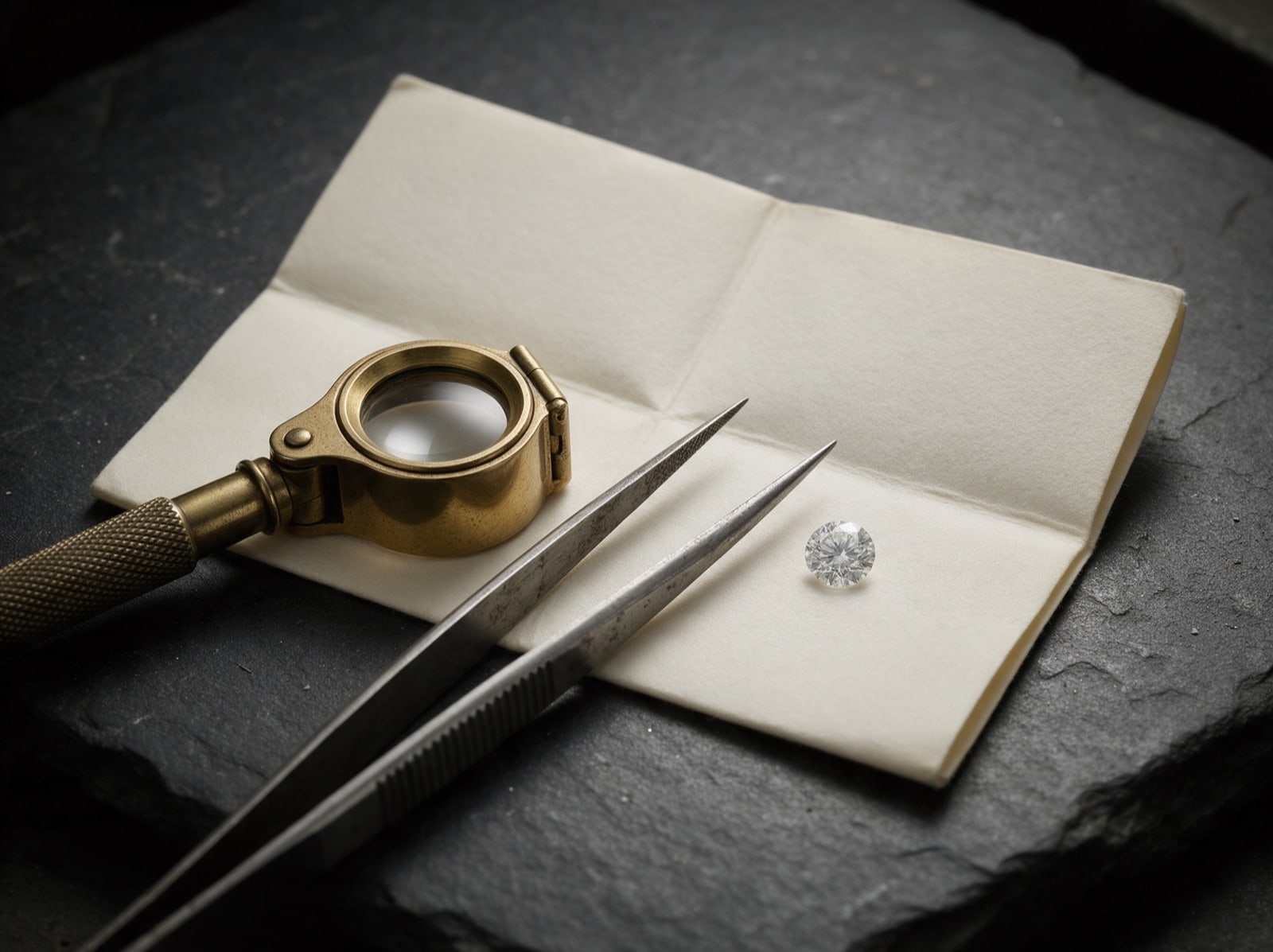
The defence takes ten seconds: read the girdle under a 10x loupe and confirm the inscribed number matches the paper. If the report claims an inscription and the stone carries none, the pairing is false.
Warning signs
None of these is subtle, and any one of them is sufficient reason to pause. A genuine seller will never object to you checking.
A valid report number always resolves. If GIA’s archive has no record, the document is not a GIA report — regardless of how convincing it looks.
Altered certificates typically change one or two fields — usually colour or clarity, occasionally carat weight. If the archive and the paper disagree anywhere, trust the archive.
If the report states an inscription and a 10x loupe finds none, the paper does not belong to that stone. This is the single most common way a genuine report is misused.
Some laboratories grade two or three grades more generously than GIA. A certificate is only as meaningful as the institution behind it, and a generous grade is not a bargain.
Verification takes under a minute and costs nothing. Any seller who resists it, or who explains why it is unnecessary in this particular case, has told you what you need to know.
Certified goods of a given grade trade in a known range. A stone far below it is usually either misrepresented, treated, laboratory-grown and undisclosed, or accompanied by a forged document.
Questions
Yes. GIA’s Report Check database is a free public service, and our tool simply passes your query to it — we charge nothing and hold no copy of GIA’s data. All you need is the report number and, for diamond grading reports, the carat weight.
First rule out a transcription error: check for a transposed digit, and confirm the carat weight is entered exactly as printed, to two decimal places. If the number still returns nothing, the document is not a genuine GIA report. Stop the transaction and, if a purchase is already under way, seek independent advice before any funds move. We are happy to look at photographs of the document and the stone at no charge.
Yes — GIA grades natural and laboratory-grown diamonds under distinctly different reports, and a laboratory-grown stone receives a GIA Laboratory-Grown Diamond Report that says so explicitly on its face. It will also carry a laser inscription identifying it as laboratory-grown. If a document is described as a standard GIA Diamond Grading Report, the stone it describes is natural.
Yes, and this is more common than outright forgery. A real report is paired with a different, lower-quality diamond of similar appearance — a practice sometimes called certificate swapping. The defence is the laser inscription: check the girdle under a 10x loupe and confirm it carries the same report number. If the stone is uninscribed but the report claims an inscription, the pairing is false.
It is a simple second factor. Requiring both means a report number alone cannot be used to pull an arbitrary record, which limits the usefulness of a stolen or guessed number. Enter the weight exactly as printed — 1.01 rather than 1.0 — or the lookup will fail even when the number is correct.
We read and assess IGI, HRD Antwerp, AGS, GÜBELIN, SSEF, AGL and GRS reports as a matter of course, and each of those laboratories maintains its own verification service. Be aware that grading standards differ materially between laboratories: a stone graded G/VS2 by one may grade I/SI1 at GIA, which is a substantial difference in value. We price against GIA-equivalent grading whichever report accompanies a stone, and we explain the adjustment openly.
Second opinion
Send us photographs of the diamond and the certificate. We will look at both, tell you plainly what we see, and charge you nothing for it — whether or not you are buying from us or selling to us.